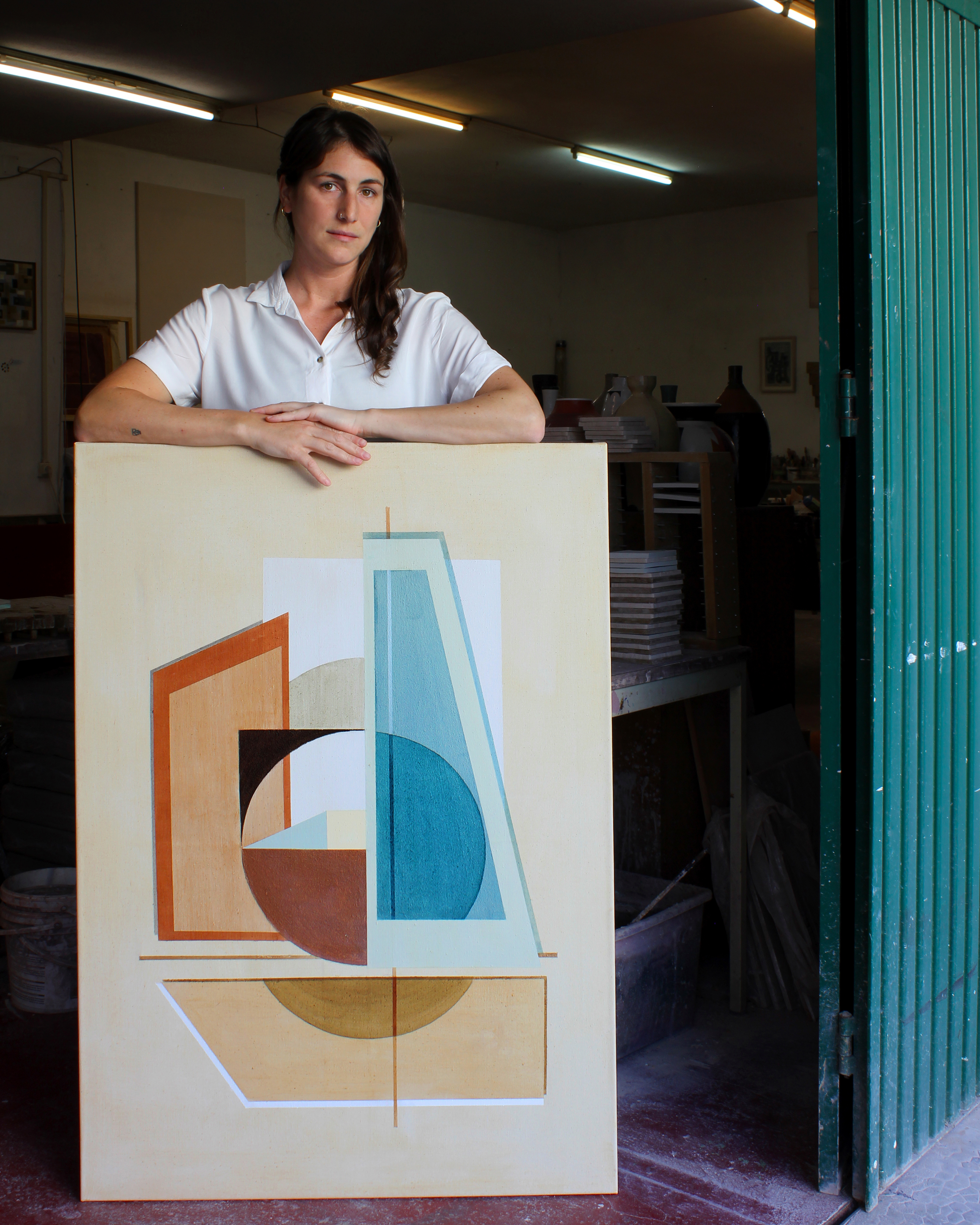
Serena Barbieri (Florence, Italy, 1987) is an Italian contemporary artist based in Porto, Portugal. Her artistic practice explores the relationship between geometry, architecture and spatial perception through painting, drawing, ceramics and site-specific interventions.
Originally trained in the sciences, Barbieri later shifted her focus towards visual arts, developing an interdisciplinary approach in which analytical thinking and artistic intuition coexist. This dual background has become a defining element of her practice, informing a visual language that combines structural precision with poetic sensitivity.
Drawing inspiration from architectural forms, scientific diagrams and systems of representation, her work investigates how space is constructed, experienced and remembered. Rather than depicting architecture itself, her compositions reveal the underlying structures that organise visual perception, transforming technical references into balanced, contemplative images. Geometry, colour and material are not merely formal devices but essential tools for exploring the relationship between human experience and the built environment.
Since relocating to Porto in 2015, Barbieri has developed an international practice through exhibitions, artist residencies, public art commissions and collaborations with galleries and cultural institutions across Portugal, France and Italy. Alongside her studio work, she has realised large-scale mural projects and interdisciplinary collaborations that extend her research beyond the traditional exhibition space.
Her work moves fluidly across different media while maintaining a coherent visual vocabulary, where painting, drawing and ceramics become complementary expressions of the same investigation into structure, rhythm and space.
ARTIST STATEMENT
My way of looking at the world was shaped by scientific thinking long before art became my language. Science taught me to observe, to question structures, to recognise patterns and relationships. Rather than leaving that perspective behind, I gradually transformed it into an artistic practice in which analytical observation and intuitive perception coexist.
My work investigates the ways in which space is constructed, experienced and remembered. Geometry, architecture and systems of representation are not subjects in themselves but tools for exploring the invisible order that underlies our perception of reality. I am interested in the point where rational structure meets sensory experience, where precision becomes a vehicle for emotion rather than its opposite.
Painting, drawing, ceramics and site-specific interventions are different expressions of the same research. Each medium offers a distinct way of engaging with space, allowing me to explore rhythm, proportion, material and colour as interconnected elements. Reduction plays a central role in my process: by removing the unnecessary, I seek forms that are both rigorous and open, capable of inviting contemplation rather than providing answers.
I do not think of abstraction as a departure from reality. On the contrary, abstraction allows me to approach reality more deeply, revealing relationships that often remain unnoticed in everyday experience. My works do not represent places or objects; they attempt to make visible the structures, tensions and balances that shape the way we inhabit the world.
Ultimately, my practice is an ongoing dialogue between scientific thought and artistic intuition. It is an attempt to transform observation into experience, creating visual spaces where order and sensitivity, logic and imagination, coexist in quiet equilibrium.

